When power is cheap, people don't think about how they use it. As prices rise and smart metering brings Time-of-Use (ToU) tariffs, when you consume becomes as important as how much. Suppliers vary kWh prices through the day to nudge usage off the 5–7pm peak. With monitoring, a few simple routine changes — running appliances overnight, avoiding standby — save real money right now.
One of the consequences of the 2022 energy crisis is that electricity prices are rapidly rising and people are starting to feel the pain in their pockets. It comes as no surprise that when power is cheap, people don’t tend to think too much about how they use it — and, as a result, how much of it they actually use.
This is when energy monitoring, and subsequent management, starts to become incredibly important. When you may not have worried unduly about your consumption beyond the usual thoughts of climate change and carbon footprint, the moment it starts to have a tangible effect on your life right now — by how much money it’s costing you — is when you start to focus on it more intently.
Aside from being mindful of how much energy you’re using — perhaps via a common energy meter clamped onto your supply or plugged into a single socket — it’s becoming more and more important to be mindful of when it’s being used.
Why timing matters now
The move to Smart Metering is the driving factor, along with the introduction of Time-of-Use (ToU) pricing tariffs by energy suppliers, where the cost per kWh varies during the day. Usually night rates are cheapest, as fewer people use power at night, and peak times such as 5pm–7pm are most expensive, as most people get home, switch on appliances and gather for a meal.
By varying prices, electrical providers are effectively trying to “nudge” Smart Meter users to mindfully alter their time of use, and therefore save money. This in turn saves the suppliers money, as they have to buy less electricity at peak times when demand — and therefore wholesale pricing — is highest.
Higher-rated appliances such as an immersion water heater, washing machine, tumble dryer or dishwasher can all benefit from this kind of monitoring and management, as many have inbuilt timers to control their operation. Lower-rated appliances may seem less important, but their aggregate consumption adds up over time — especially devices left in standby mode.
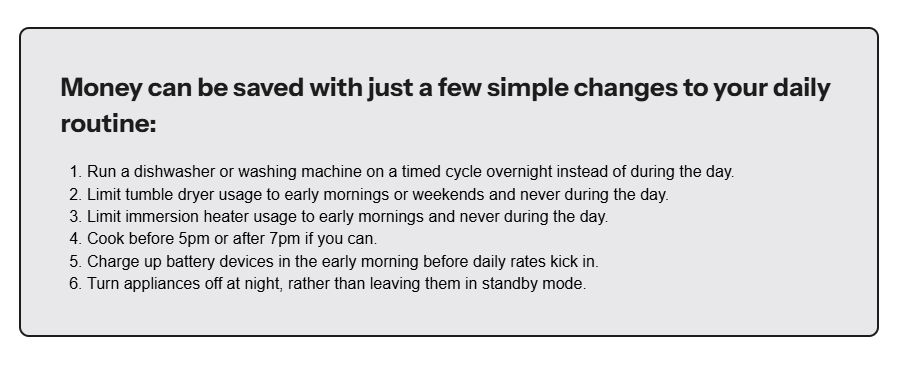
Money can be saved with a few simple changes
- Run a dishwasher or washing machine on a timed cycle overnight instead of during the day.
- Limit tumble dryer usage to early mornings or weekends and never during the day.
- Limit immersion heater usage to early mornings and never during the day.
- Cook before 5pm or after 7pm if you can.
- Charge up battery devices in the early morning before daily rates kick in.
- Turn appliances off at night, rather than leaving them in standby mode.
By being mindful of the time of day at which you consume electricity, there are savings to be made right now — achieved through careful monitoring of your usage during the day.
If you don’t have a Smart Meter with a ToU tariff, now could be a good time to look into it to save money. Some tariffs even include “free power” during a weekend daytime — take advantage of it to run a washer, dryer, or just mow the lawn with your electric mower.
Where Full Stack Energy fits
Measurement is the foundation of management — exactly what our Advisor energy analytics platform delivers, at scale, for organisations. The same principle scales from a home appliance to an entire estate: see when energy is used, and you can shift it to where it’s cheapest and cleanest. It’s the everyday version of treating timing as the lever.