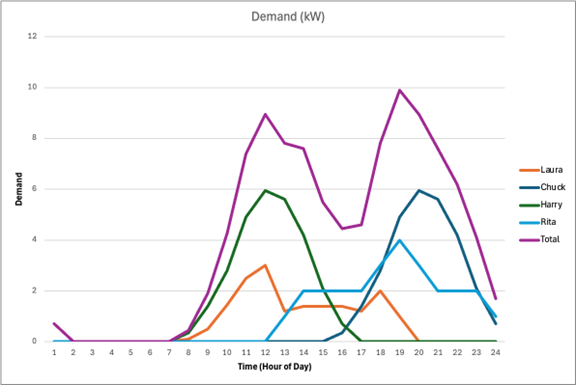
A charge-point operator needed to deploy EV charging across a developer's apartment complexes — profitably, conveniently, and at the right scale. We modelled residents as charging "personas", layered Time-of-Use tariffs on top, and sized the infrastructure precisely so no money was wasted on chargers nobody would use.
The rapid adoption of EVs brings both opportunity and complexity: owners want a seamless charging experience, but complex tariffs and infrastructure decisions make that hard to deliver profitably. Full Stack Energy was approached to optimise residential EV charging for a charge-point operator serving a prominent property developer's apartment complexes. Using detailed demographic analysis, Time-of-Use tariff modelling, real-time data optimisation and scalable infrastructure modelling, we helped the operator deploy and run chargers profitably — minimising inconvenience to residents while avoiding both surplus capital spend and costly utility peak penalties.
EV owners want charging that’s as convenient as filling a tank, but charge-point operators face two structural headaches: complex electricity rate structures and unpredictable user demand. Together they make it genuinely hard to deploy and operate chargers profitably — price wrong or build wrong and the economics collapse.
A prominent residential property developer wanted to manage EV charging within their apartment complexes. Their constraints were specific: minimal inconvenience to residents, optimal cost-efficiency, and sustainable revenue for the operator running the chargers.
So the operator needed answers to three linked questions — how to handle complex price structures, how to cope with unpredictable demand patterns, and how to predict and manage sustainable revenue from charging — before committing capital to hardware.
We started from who actually lives there. Demographic data became charging “personas”, those personas drove demand, and demand met Time-of-Use tariffs and a precise infrastructure plan.
You can't price charging you can't predict. Model the residents as personas first, and the demand — and the right tariff — stops being a guess.
Lead Engineer, Full Stack Energy
Optimised charging schedules significantly reduced peak loads — translating into lower operational costs and the avoidance of costly utility penalties — while precise charger-deployment modelling ensured the complexes had adequate infrastructure without surplus investment. The operator could deploy with confidence rather than over-building “just in case”.
Residents benefited from cost-effective, convenient charging, which promotes EV adoption and satisfaction, and the operator ended up with a robust, scalable framework that adapts to future demographic changes or expansions. The result bridges a visionary idea and a market-ready, profitable deployment.
The move that made this work was refusing to start from the tariff. Everyone wants to jump straight to pricing, but in an apartment block the real unknown is behaviour — who owns EVs, how far they drive, when they plug in. Model that as personas first and the tariff and the charger count almost fall out of it.
The quiet win is the charger-count modelling. Operators tend to over-build out of fear of complaints, and every unused charger is dead capital. Being able to say “you need this many, not that many” is often worth more to the business case than the tariff optimisation itself.
Start with behaviour, not price. Resident demographic data becomes charging "personas" that reveal EV ownership, weekly mileage and peak charging hours. Layering Time-of-Use tariffs on that modelled demand identifies the cost-sensitive windows and scheduling that keep charging profitable for the operator and convenient for residents.
Operators tend to over-build out of fear of complaints, and every unused charger is dead capital. Scalable infrastructure modelling sizes the precise number of chargers the personas' demand justifies — enough to serve residents without surplus capital spend, while staying expandable for future growth.
Time-of-Use-optimised charging schedules shift load into cost-sensitive windows and flatten peaks, and real-time analytics adjust charger operation as conditions change. That cuts peak loads and the costly utility penalties that come with them.
Model the people before the tariff. We turn resident behaviour into demand, pricing and the right number of chargers. Let's talk.