The plant was already running well. That was the problem — running well, at a fixed setpoint, meant it was ignoring a power market that swings from expensive to negative inside a single afternoon. We taught it to pay attention.
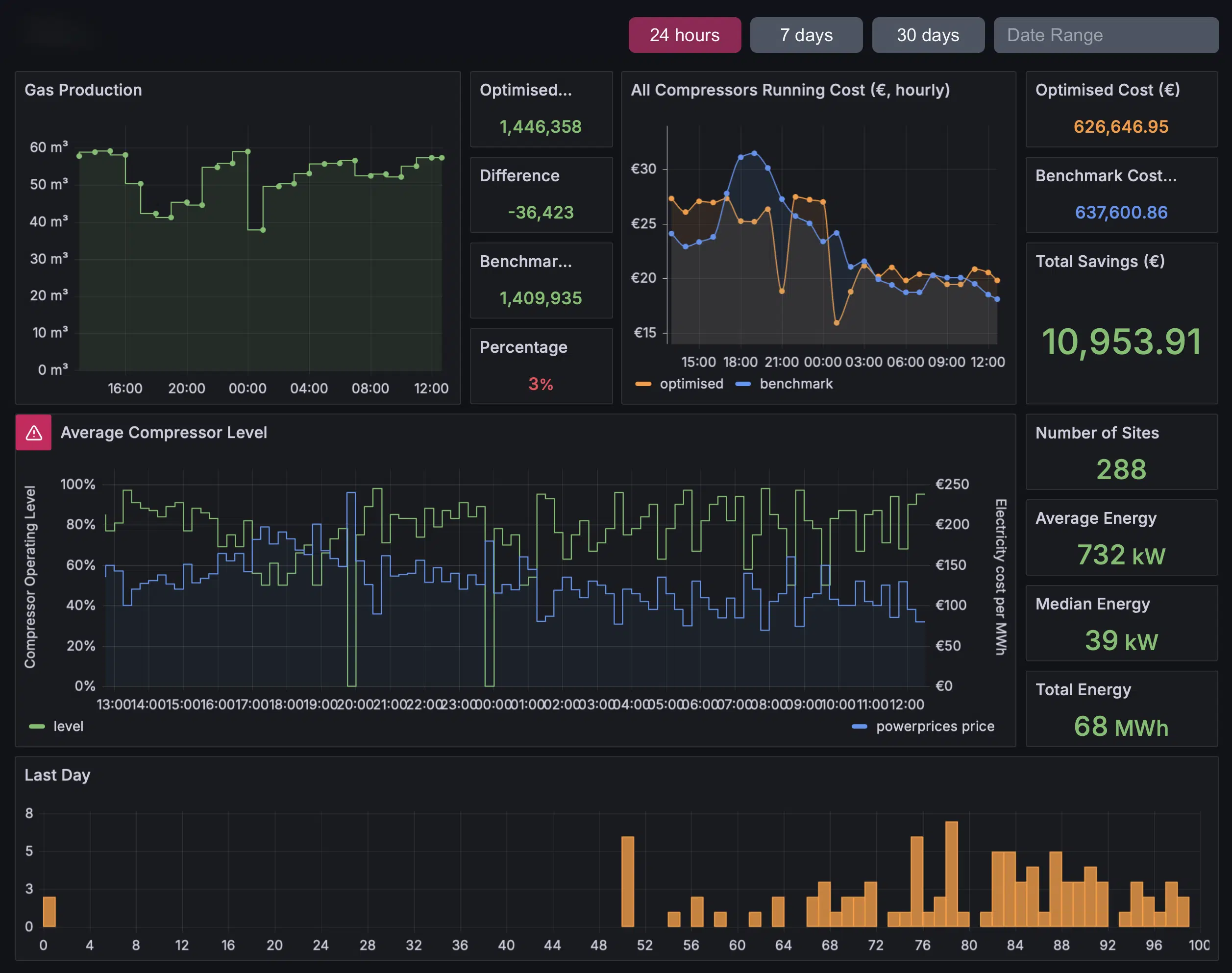
A German biogas producer was running its upgrading compressors at a flat ~80% load around the clock, regardless of electricity prices. Full Stack Energy built a linear programming (LP) optimiser, a physics-accurate digital twin of the plant, and an IoT control layer that dispatches the site against 15-minute day-ahead prices and on-site solar. The first deliverable wasn't software — it was the business case that won the board's approval to invest.
Biogas plants are conservative for good reasons. The biology doesn’t like surprises, the compressors are expensive, and uptime pays the bills. So most operators pick a sensible load — here it was around 80% — and leave it there. Set and forget.
The trouble is that electricity prices don’t sit still. On a windy, sunny afternoon the German day-ahead price can go negative; on a still winter evening it spikes. A plant running flat out through both is buying power when it’s dear and giving away flexibility it’s never paid for. The asset was performing technically and underperforming commercially — and nobody could point to exactly where the gap was.
That last part is the bit that mattered. The operator suspected there was money on the table. What they didn’t have was a number they could defend to a board, or a system that could actually capture it without someone babysitting a spreadsheet.
We don’t ask anyone to buy a control system on faith. The order of work was deliberate: prove the money exists on paper, then go and capture it.
Dispatch is a design choice. A plant that can't respond to price isn't broken — it just never had the chance to decide.
Lead Engineer, Full Stack Energy
The modelling phase did something a sales deck never could: it put a defensible, plant-specific figure in front of the people who sign off capital. The optimisation case was strong enough that it drove the board’s decision to invest — the project stopped being an engineering curiosity and became a budget line.
With the case approved, the dispatch logic went live. The plant now follows the price curve instead of a flat setpoint. The biology is still happy; it’s just no longer paying for the privilege of ignoring the market.
The hard part of this job wasn’t the maths. Linear programming is well-trodden ground. The hard part was earning enough trust in the digital twin that the operator believed its schedule on a day when the price did something strange — because those are exactly the days the money is made or lost, and exactly the days a fixed-load plant is most tempted to do nothing.
If you run an asset like this and you’ve never seen the cost of standing still written down, that’s the first conversation to have. It usually starts with a model, not a sales pitch.
Many upgrading plants run their compressors at a fixed load to protect biology and uptime. That makes the asset blind to the power market — it buys and sells electricity at the same rate whether prices are high or negative. The lost value sits in the gap between a flat setpoint and a price-aware dispatch schedule.
It is deciding, for every settlement period, how hard to run each piece of equipment so the plant follows electricity prices and on-site generation while respecting biological, storage and mechanical limits. Full Stack Energy solves it with a linear programming optimiser that produces a 15-minute schedule against day-ahead prices, then dispatches it automatically through an IoT control layer.
The modelling phase produced a defensible business case within weeks, which is what the client took to its board. A working control system followed once the case was approved. We deliberately lead with the model so a client can see the upside before committing capital.
That hunch is usually right. The cheapest way to find out is a model — let's build one.