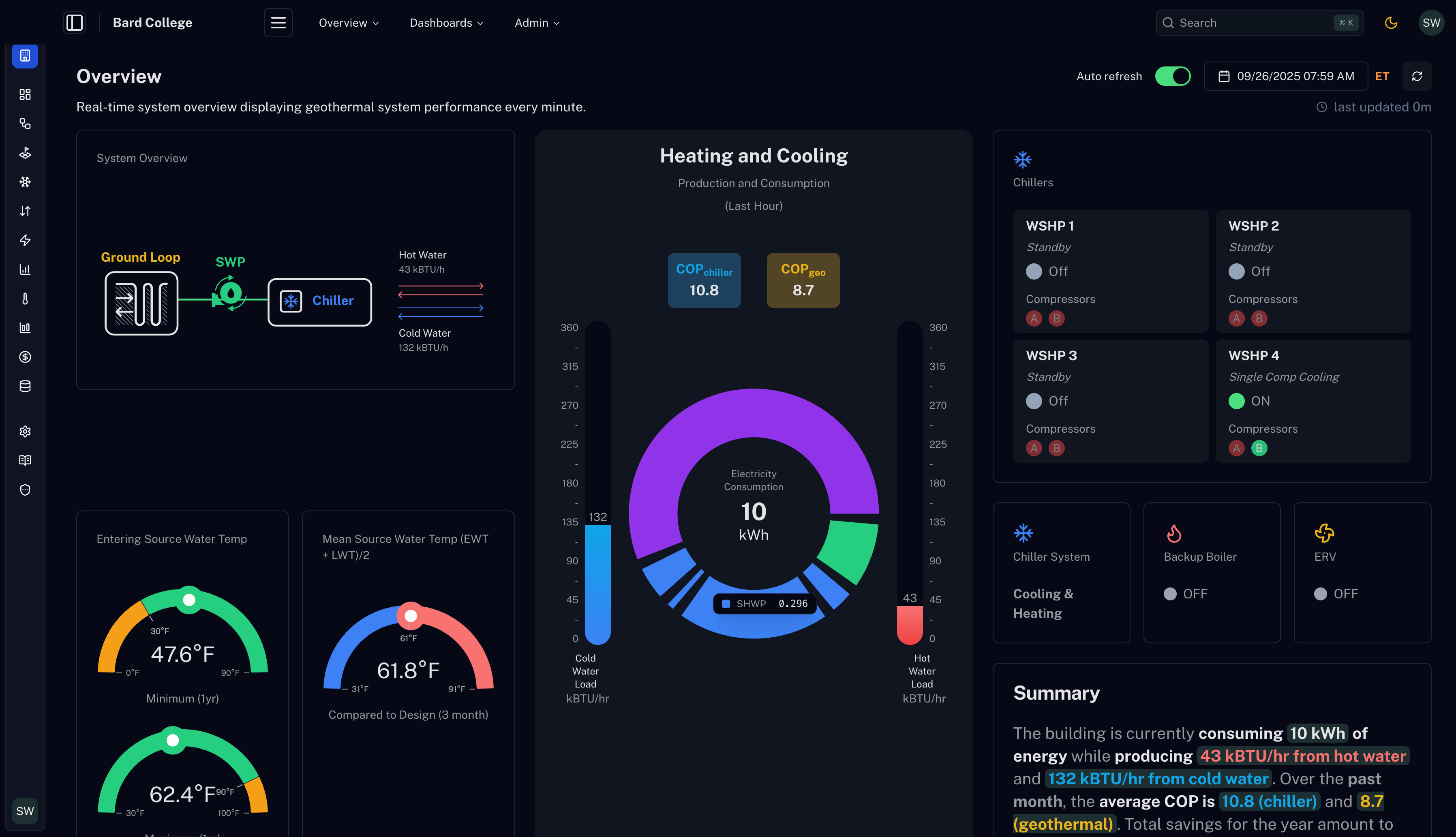
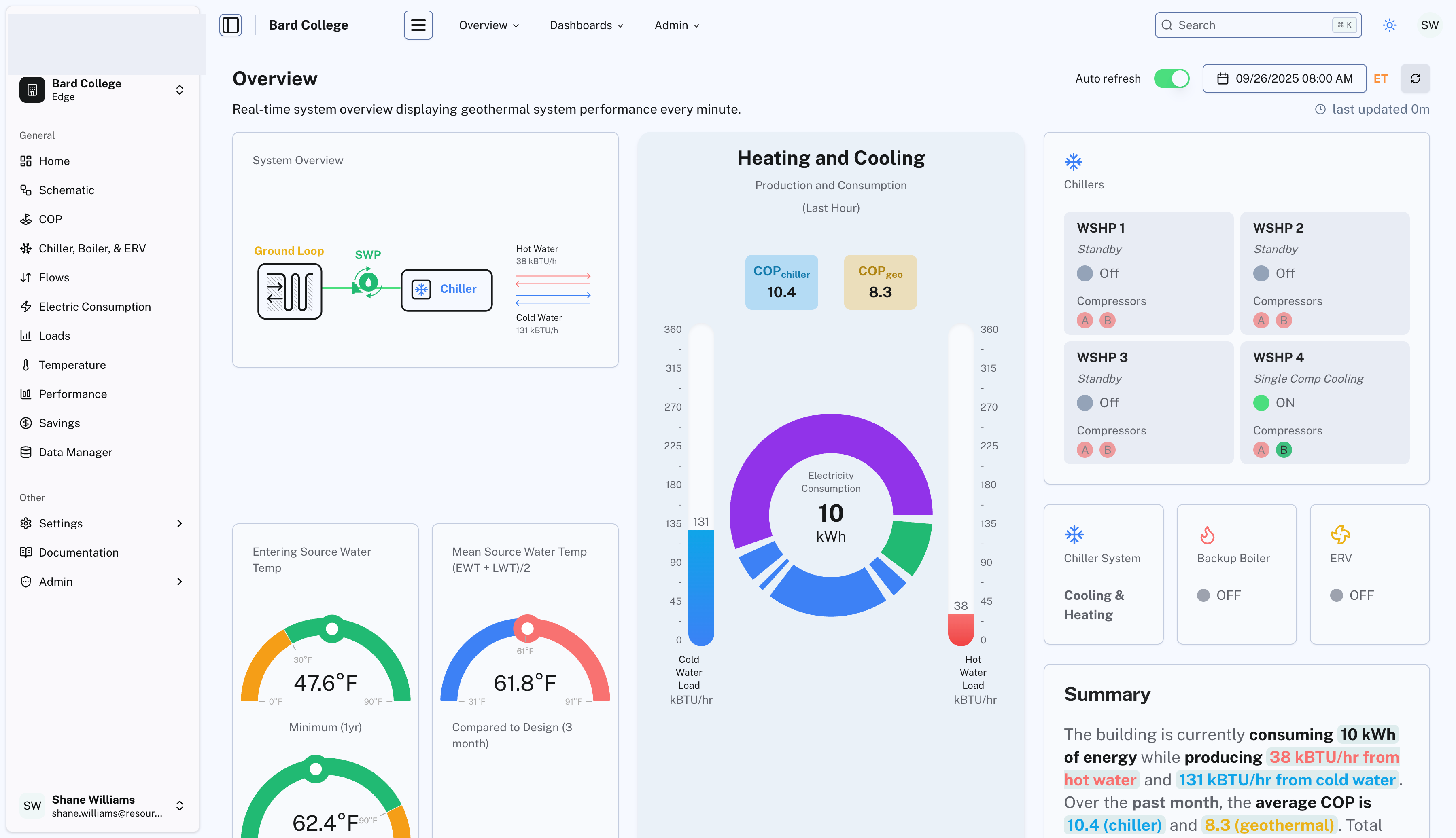
Our client designs and operates large-scale geothermal heating and cooling for high-profile blue-chip venues in New York City. The systems performed — but nobody could see them behaving in real time. We built the platform that gave them that view, and a proprietary asset to go with it.
Full Stack Energy's client designs and operates large-scale geothermal heating and cooling systems for high-profile blue-chip venues in New York City. They lacked instant, actionable insight into how every well-field, pump and heat-exchanger was behaving in the real world. We deployed a team of mathematicians, software engineers and UX designers to build a cloud-based data-acquisition and monitoring system, plus a bespoke online portal — turning raw telemetry into real-time visibility and a proprietary platform the client now owns as intellectual property.
Geothermal heating and cooling is steady and reliable, which is exactly why it can become a black box. Our client operated these systems for prestigious New York venues, but without real-time insight into every well-field, pump and heat-exchanger they were exposed on three fronts: hidden efficiency losses inflating operating costs, slow fault detection that could jeopardise client comfort and contracts, and a technology ceiling that would stall future scaling.
The geothermal industry is competitive and fast-moving — shaped by new technology, sustainability pressure and rising client expectations. Incremental improvement wasn’t enough. The client wanted something more tangible from a corporate standpoint: an asset that would stand up in the boardroom as much as it performed in the field.
So the brief was twofold. Deliver operational excellence — real-time visibility into the assets — and, in doing so, create a unique, defensible market position the competition couldn’t replicate.
We built a resilient pipeline from the client’s equipment to the cloud, then a portal that served both the client’s engineers and, in a simplified form, their own customers — owning the complexity so the client could own the results.
We blend domain depth with end-to-end engineering — mathematicians, software architects and UX specialists embedded with the client's own team. We own the complexity so the client can own the results.
Lead Engineer, Full Stack Energy
The client now runs its geothermal assets with the same rigour as a mission-critical data centre. An ultra-low-latency pipeline — MQTT to Telegraf to InfluxDB — delivers sub-second refresh from hundreds of sensors per site, so engineers spot anomalies before occupants ever feel them. New facilities can be added in minutes rather than weeks, field teams diagnose issues visually, and executives get KPI dashboards instead of raw data dumps.
Security is built in: end-to-end encryption, segregated data buckets and role-based access safeguard each customer’s IP and competitive edge. And because the platform is proprietary and bespoke, it became part of the client’s own intellectual property — a unique, in-house system their competitors simply don’t have, materially enhancing company valuation and investor appeal.
The reason we lead with monitoring on assets like this is trust and visibility before anything else. You can’t optimise — or sell the value of — a system you can’t see. Once the client could watch hundreds of sensors refresh in real time, the conversation shifted from “is it working?” to “what else can we do with this?”
The part clients often don’t expect is the corporate upside. We didn’t just hand over software; we built them a proprietary platform that’s now a balance-sheet asset. For an operator in a competitive market, owning the IP is as valuable as the operational gains it delivers.
Geothermal systems are steady and reliable, which can turn them into a black box. A real-time platform streams telemetry from every well-field, pump and heat-exchanger, so engineers spot efficiency losses and faults before occupants ever feel them — moving the asset from "is it working?" to actively managed.
Field equipment streams over MQTT into a Telegraf ingestion layer that loads InfluxDB time-series buckets, visualised through a bespoke Grafana portal with both dashboards and vector-graphics schematics. The client's engineers get a full view and their own customers get a simplified one, all running on AWS.
Because a proprietary, in-house system becomes intellectual property the client owns. Alongside the operational gains — sub-second refresh, new sites added in minutes, role-based security per customer — it gave them a defensible market position and a balance-sheet asset competitors don't have.
Visibility is the foundation everything else builds on — and, done right, it becomes an asset you own. Let's talk about your systems.