
As the world transitions to cleaner, decentralised power, a major question emerges: How do we design renewable energy systems that are both cost-effective and reliable?
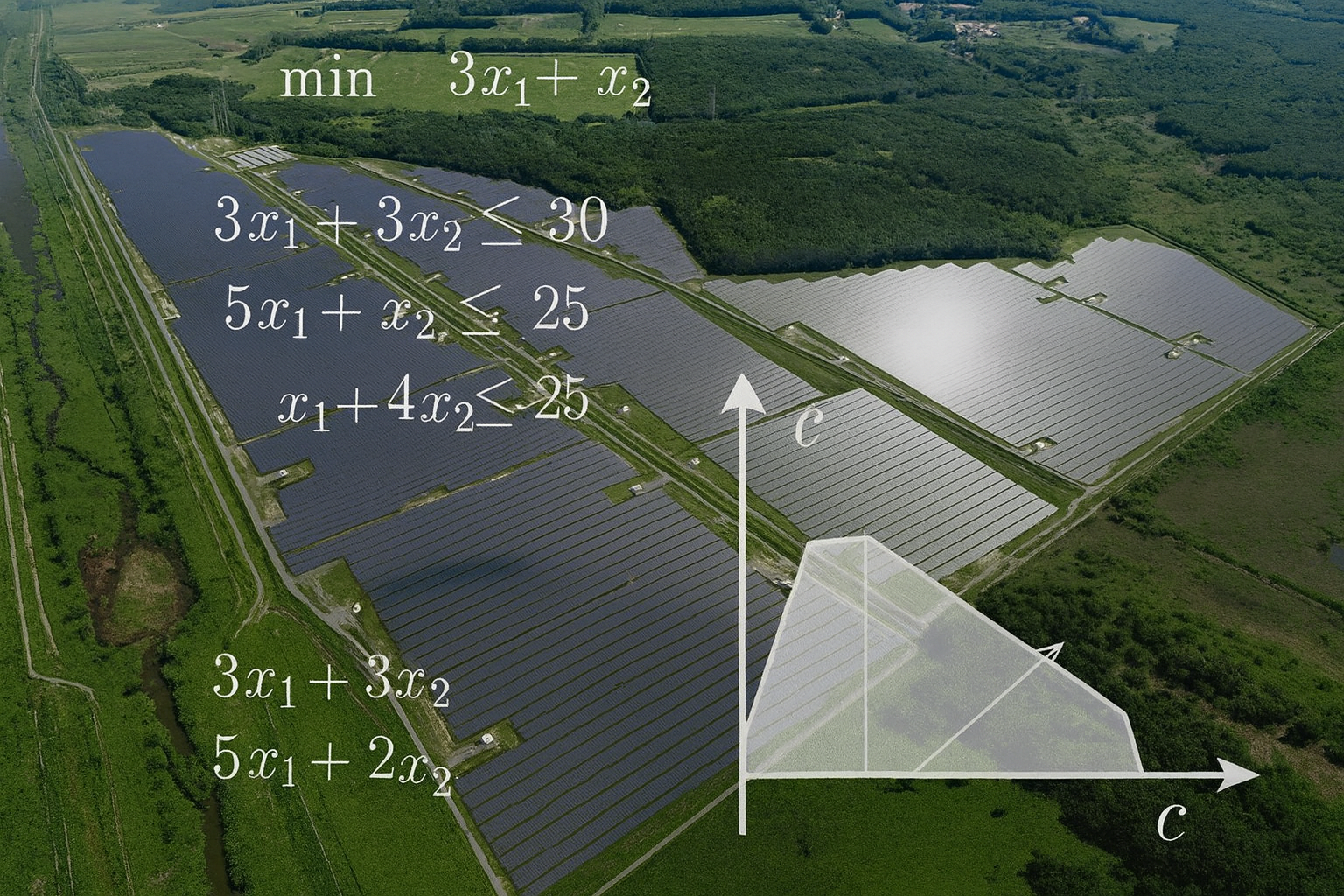

As the world transitions to cleaner, decentralised power, a major question emerges: How do we design renewable energy systems that are both cost-effective and reliable?
Solar output varies with cloud cover, batteries have performance limits, demand fluctuates, and backup resources all carry different costs. Choosing the right mix of technologies — and deciding how to operate them over time — is not simple.
This is exactly the type of challenge that linear programming (LP) was built to solve.
For decades, LP has been used in the energy industry for tasks like generator scheduling and hydro optimisation. Today, those same optimisation principles are essential for renewable-heavy systems.
What Makes LP a Natural Fit for Renewables?
Linear programming excels at problems that involve:
- multiple resources
- capacity limits
- costs or emissions to minimise
- demand to satisfy
- physical constraints to obey
LP models combine decision variables, an objective function, and constraints related to productive capacity and resource limits. These map perfectly onto renewable energy systems.
Before diving into the renewable context, it helps to revisit what LP looks like visually.
Linear Programming in One Picture

Figure 1 — A simple linear program. The shaded region shows all points that satisfy the constraints. The arrow indicates the direction of improvement for an example objective function.
This geometric view helps clarify how LP identifies the “best” solution inside a space of feasible ones — a valuable mental model for understanding renewable system design.
The Renewable Capacity-Planning Challenge
When designing a renewable-powered site, planners must address key questions:
- How much solar PV should we install?
- How large should the battery be?
- Should we include a generator, or rely on the grid for backup?
- How do we control cost while maintaining reliability?
A big part of the challenge arises from mismatched timing: demand peaks in the morning and evening, while solar peaks around midday.
The Core Mismatch: Demand vs Solar Output

Figure 2 — A typical daily demand curve (two peaks) compared with solar PV output (midday peak). Optimisation is needed to bridge the gap.
This mismatch is why renewable systems can’t simply be sized by rule of thumb — and why LP is essential.
How LP Structures a Renewable Planning Problem
LP turns renewable-system design into a clear optimisation model:
- Define the decision variables
- kW of solar
- kWh of storage
- Generator capacity
- Hour-by-hour output levels
- Grid import/export
- Define an objective function
Typical goals include:
- minimise total cost over the system lifetime
- minimise fuel use
- minimise emissions
- maximise reliability
- Add constraints
- resource constraints (e.g., solar limited by irradiance)
- productive capacity (battery charge/discharge limits)
- continuity constraints (energy balance per hour)
- upper/lower bounds (generator limits, battery capacity)
- budget limits
- demand satisfied in every timestep
Once all these elements come together, the LP solver can determine both the optimal capacity mix and the optimal operating schedule.
LP in Action: Turning Variability Into Optimised Decisions
Below is an example of what LP can produce — a full, hour-by-hour dispatch plan using solar, storage, a generator, and grid import to meet demand at minimum cost.
Optimised Dispatch Schedule

Figure 3 — An LP-optimised dispatch schedule. Solar provides daytime power, storage fills gaps during critical hours, and residual demand is met through a generator and/or grid import.
This is LP at work: transforming variable supply and variable demand into a coherent, cost-optimal plan.
Full Stack Energy: Where Energy Quants Thrive
At Full Stack Energy, these are exactly the kinds of complex, multi-layered optimisation challenges we love.
Where others see:
- variability,
- uncertainty,
- thousands of interacting constraints,
- and an overwhelming number of possible system configurations…
…our team sees a mathematical puzzle waiting to be solved.
Our energy quants, mathematicians, and optimisation specialists thrive on turning renewable and capacity-planning challenges into elegant, cost-optimal solutions.
We combine rigorous mathematical modelling with deep energy domain expertise and modern optimisation techniques to deliver clarity where there was once complexity.
Whether you’re looking to:
- identify the optimal mix of solar, storage, and backup assets,
- reduce operational and energy costs,
- enhance system reliability,
- or understand the impact of tariff changes and demand patterns…
…we’re here to help you build a system that's technically robust and commercially sound.
Conclusion
Renewable capacity planning can seem complex — and it is. Solar, storage, generators, and grid connections all behave differently, cost differently, and interact in subtle ways. But linear programming turns this complexity into a structured optimisation problem.
Thanks to LP, planners can build systems that are:
- clean
- cost-effective
- reliable
- future-proof
…and mathematically justified.
LP may be decades old, but in the age of renewables, it has never been more relevant.
Need help with capacity planning? Let’s talk.
If you’re facing challenges around:
- renewable system sizing
- storage planning
- generator scheduling
- tariff optimisation
or any energy capacity modelling problem we’d love to help.
Get in touch with Full Stack Energy
Contact us.
Posts.
 03.20.26
Why Price Signals Don’t Translate Into Real Energy Behaviour
-
03.05.26
Designing for Systems: Why We’re Rethinking the Interface
-
02.27.26
Dispatch Is a Design Choice
- 02.17.26
Optimizing Production Schedules with Mixed-Integer Linear Programming
- 01.29.26
Data Centers, AI, and the Grid: Structural Demand or a Speculative Moment?
 12.12.25
The EU’s Net-Zero Industry Act: Why a kW Is No Longer Just a kW
- 12.03.25
How Linear Programming Helps Solve the Capacity-Planning Challenge for Renewables