The client retrofits buildings to cut energy costs, but plenty of SMEs who want the savings can't fund the upfront work. We built the M&V platform that verifies savings precisely enough to make a no-down-payment, shared-savings model credible to both customers and utilities.
The client is a US energy-efficiency building and retrofit company that reduces energy costs for SMEs and capacity problems for utilities. They wanted to reach more SMEs who saw the value of retrofitting but lacked the capital. Full Stack Energy built a turn-key M&V circuit audit platform — advanced audit analysis, pre-installation circuit testing and validation, circuit-level metering and backend disaggregation — that verifies savings through direct measurement, enabling a shared-savings model where customers pay from the savings with no initial down payment. The platform is rolled out to multiple utility programmes across the US, reaching hundreds of thousands of customers.
The client uses sophisticated CRM, sales and supply-chain tools to cut energy costs for SMEs and ease capacity problems for utilities. Their constraint wasn’t demand — plenty of small and medium businesses could see the savings a retrofit would bring. It was capital: those same SMEs didn’t have the down payment to invest.
The unlock is a shared-savings model — the customer pays nothing up front and repays from the savings the retrofit generates. But that model only works if everyone trusts the savings number. A customer won’t sign, and a utility won’t back it, on an estimate.
So the client needed a turn-key energy assessment and measurement tool that would guarantee savings from day one and recoup its cost from those savings — which made measurement and verification the heart of the whole business model, not an afterthought.
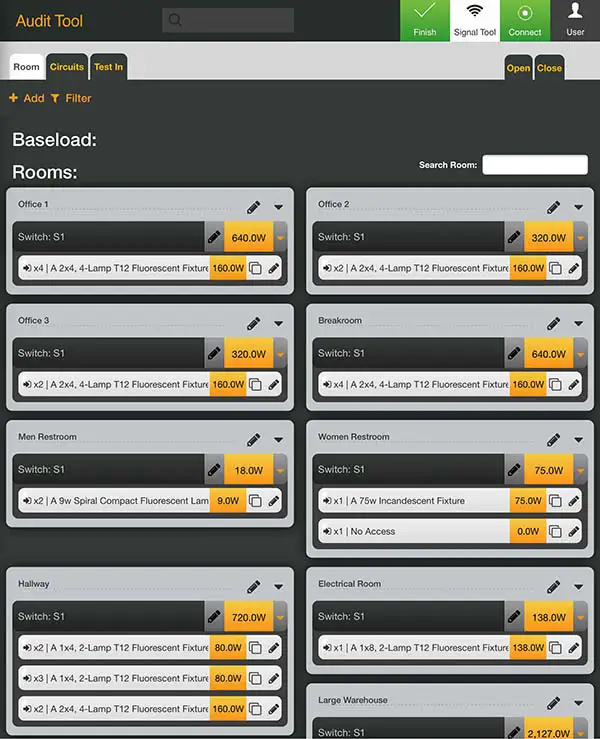
We ran a proper business-analysis stage, then built field hardware and a touch-first app that captures clean data fast — feeding a disaggregation backend that turns measurement into verified, financeable savings.
A shared-savings deal is only as good as the measurement under it. Make the saving provable and the financing takes care of itself — no down payment required.
Lead Engineer, Full Stack Energy
Deep energy-domain knowledge let the team build an intuitive experience that required minimal training, significantly cut audit time and increased accuracy. In the field, the app maps loads to circuits — which doubles as supervised training data for the machine-learning models and supports the commissioning of wireless sensors.
That combination of domain depth and engineering let the team and client collaborate on solutions a generic software contractor couldn’t offer. The platform is now rolled out to multiple utility programmes across the US, reaching hundreds of thousands of customers.
The unsexy heart of this project is trust in a number. The whole no-money-down model collapses if a utility doubts the saving, so every design decision — revenue-grade meters, pre-install validation, disaggregation — exists to make that number defensible. The slick iPad app is what people notice; the M&V rigour is what makes the business work.
Building the audit app so it also generates supervised training data for the ML models was the quiet win. The technician doing their normal job — dragging circuits to switches — is simultaneously labelling data that makes the disaggregation smarter. Good field UX and good ML turned out to be the same problem.
A shared-savings model only works if everyone trusts the savings number — a customer won't sign and a utility won't back it on an estimate. The platform verifies savings through direct measurement, so SMEs can retrofit with no down payment and repay from the savings the retrofit actually generates.
It combines advanced audit analysis, pre-installation circuit testing and validation, revenue-grade circuit-level metering and backend disaggregation. Technicians use a touch-first iPad app to drag circuits and switches for fast, accurate on-site data capture, feeding a backend that turns measurement into financeable savings.
When a technician maps loads to circuits in the app, that work doubles as supervised training data for the machine-learning disaggregation models — so good field UX and better ML are the same task. The platform is rolled out across multiple US utility programmes, reaching hundreds of thousands of customers.
Shared-savings and performance contracts live on trustworthy measurement. We build the M&V that makes the number defensible. Let's talk.