Near the cusp of the Mandelbrot Set at c = 0.25, count how many iterations I of the feedback equation z² + c it takes to escape past 2.0 when you start a tiny distance ε beyond the cusp. As ε shrinks, those iteration counts spell out the digits of π — and √ε × I converges on π directly. It's beautiful, and the least efficient method of computing π you'll ever meet.
Perhaps your machine is AC powered from a tidal source or wind generator and there are phase-angle calculations to make for the flux capacitor to power up. Suffice it to say you really need a good approximation of π for things to work just right — and you can’t remember it to enough decimal places. Given a pencil, some paper and a simple calculator, there just may be a way, if you have a good recollection of the Mandelbrot Set and its properties.
Its calculation is based on the concept of prisoners and escapees — quite relevant to our island scenario. The core of the computation is a feedback equation of the form z² + c. Feeding the result back in from z = 0.0 gives an infinite sequence:
As the sequence progresses, the result either shrinks or grows without bound: the original point is either imprisoned within the set or escapes it. If a number’s iterations stay ≤ 2 it’s in the set; if they exceed 2 it’s out. (The value 2 is an arbitrary boundary that comfortably encompasses the whole set for our purposes.)
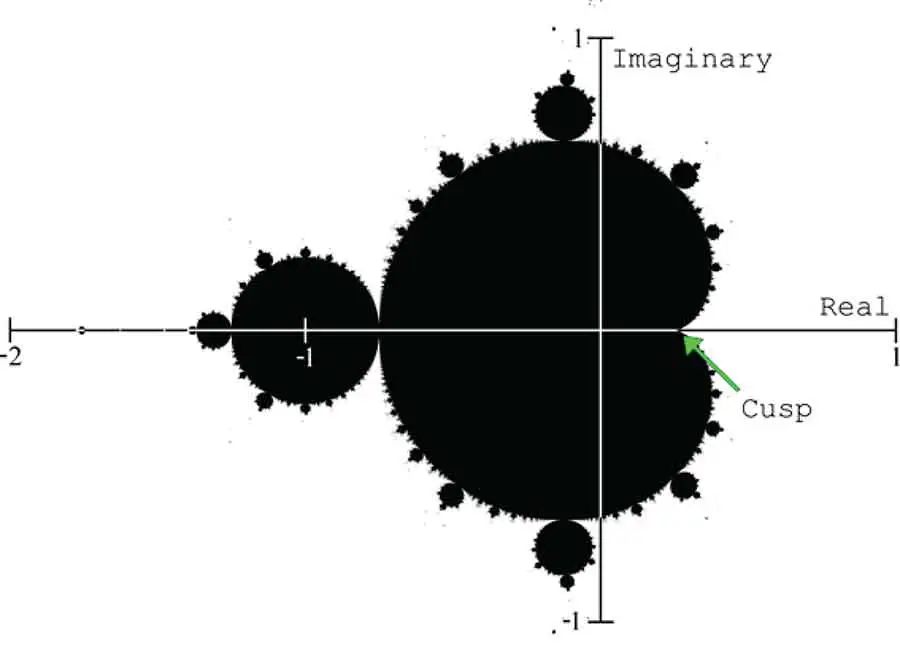
What happens near the cusp?
The set crosses the x-axis exactly at x = 0.25 — the cusp. Anything ≤ 0.25 is in the set; anything greater escapes. Take c = 0.25 as our starting point and explore values just a little bigger, c + ε, asking how many iterations I(c) it takes for the result to grow past 2.0. With ε = 1.0 (so c = 1.25):
I(0): 0.0²    + 1.25
I(1): 1.25²   + 1.25
I(2): 1.5625² + 1.25 = 2.8125  [bang — bigger than 2.0]
Two iterations. With ε = 0.5 (c = 0.75) it again takes two. With ε = 0.3 (c = 0.55):
I(0): 0.0²    + 0.55
I(1): 0.3025² + 0.55 = 0.8525
I(2): 0.8525² + 0.55 = 1.2767
I(3): 1.2767² + 0.55 = 2.1801…  [bang]
Three iterations. Tabulating ε against the iterations to escape:
| ε | I(c) |
|---|---|
| 1.0 | 2 |
| 0.1 | 8 |
| 0.01 | 30 |
| 0.001 | 97 |
| 0.0001 | 312 |
| 0.00001 | 991 |
| 0.000001 | 3140 |
| 0.0000001 | 9933 |
| 0.00000001 | 31414 |
| 0.000000001 | 99344 |
| 0.0000000001 | 314157 |
| 0.00000000001 | 993457 |
| 0.000000000001 | 3141625 |
Can you see what’s happening?
As we approach 0.25 with ever-smaller offsets, the iteration count alternately approximates the digit sequence of π. Even with only a rough memory that π starts “3.something”, you can place the decimal point and read off the answer. But there’s something subtler. Add a column of √ε × I(n):
| ε | I(n) | √ε × I(n) |
|---|---|---|
| 1.0 | 2 | 2.000000 |
| 0.1 | 8 | 2.529822 |
| 0.01 | 30 | 3.000000 |
| 0.001 | 97 | 3.067409 |
| 0.0001 | 312 | 3.120000 |
| 0.00001 | 991 | 3.133817 |
| 0.000001 | 3140 | 3.140000 |
| 0.0000001 | 9933 | 3.141090 |
| 0.00000001 | 31414 | 3.141400 |
| 0.000000001 | 99344 | 3.141533 |
| 0.0000000001 | 314157 | 3.141570 |
| 0.00000000001 | 993457 | 3.141587 |
It’s a little like magic: √ε × I(n) is an approximation to π on every row, and it’s closing in — no need even to insert the decimal point yourself.
It’s the most inefficient method of approximating π I’ve ever come across — but it’s certainly something you could do on a desert island while awaiting rescue. A lot of time.
Extra credit
If you have a powerful machine and want to continue the sequence, here’s the Mathematica snippet for counting iterations:
ostart = 0.25;
e = 0.0000000000000001;
c = ostart + e;
iter2[x_] := x^2 + c;
Length[NestWhileList[iter2, c, # <= 2.0 &]]
As the iteration count grows, so do floating-point rounding errors, so there’s a machine-dependent limit to how far you can go. There are many other ways to approximate π using the Mandelbrot Set, but this is about the simplest — and it avoids complex numbers entirely, even if the arithmetic is intensive.
From island maths to energy data
Curiosities like this are the same pattern-spotting instinct we bring to operational data — finding the structure hiding inside a stream of numbers. It’s exactly what powers AI in the energy sector and anomaly detection like finding needles in the digital haystack.