Most batteries are run by optimising a schedule against a single day-ahead price forecast — which throws away the asset's option value. Operators who price the full range of futures instead (the method that has run Brazil's hydro grid since 1991) capture far more in volatile markets. A dam and a battery are the same problem in different clothes.
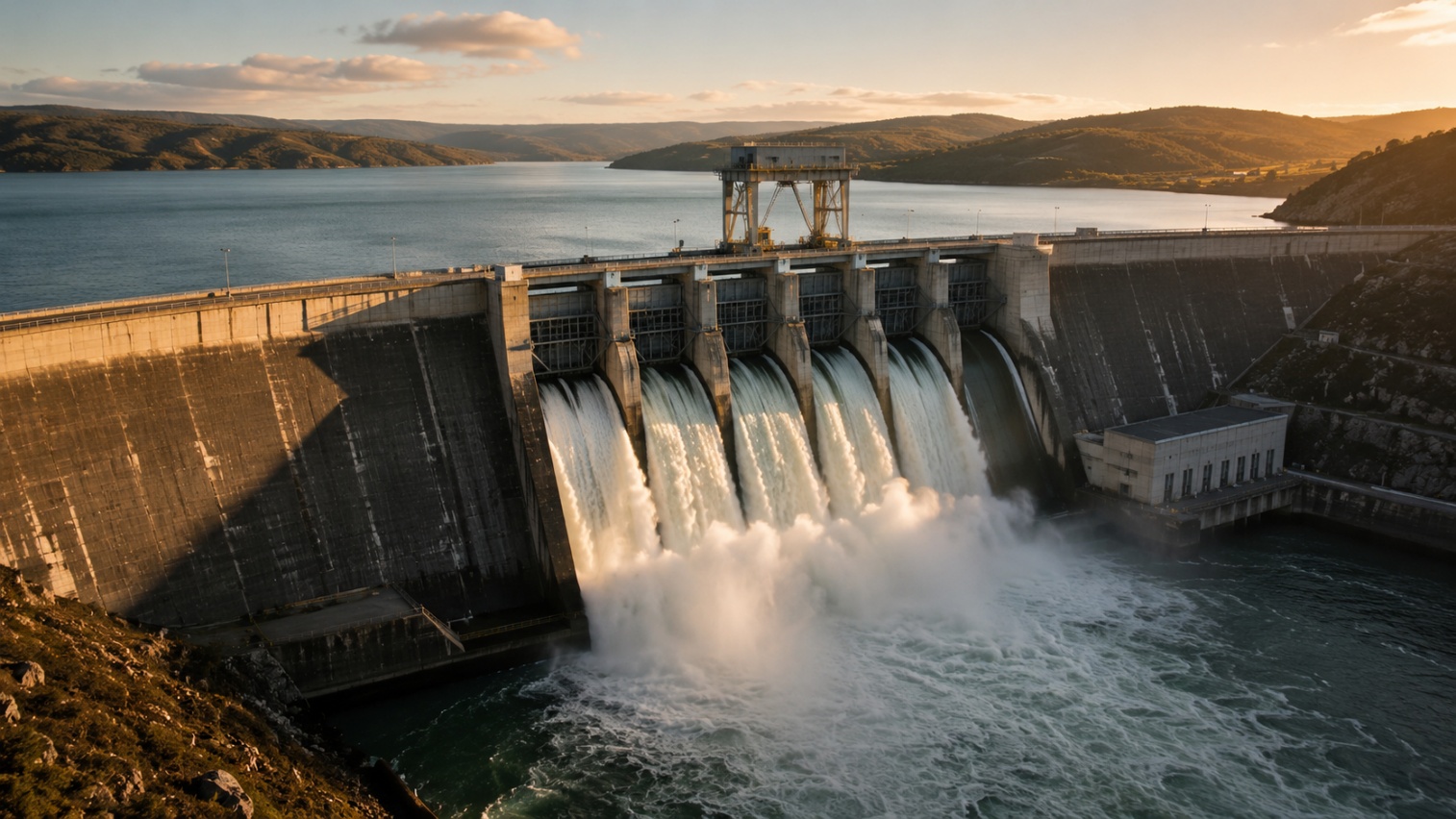
Picture a dam operator on a Monday morning. The reservoir is two-thirds full, and they have to decide how much water to send through the turbines this week. Release a lot and they earn this week’s price. Hold it back and they might earn far more in a fortnight, when a cold snap sends prices soaring — or they might be caught out by heavy rain that forces them to spill water they could have sold. They do not know next week’s rainfall. They do not know next week’s price. And whatever they choose today changes the choices they will have every week after.
That is one of the oldest problems in energy. It now sits inside every grid-scale battery on the network.
The forecast you already know is wrong
Most batteries today are run on a tidy loop: forecast tomorrow’s prices, optimise the charge and discharge schedule against that forecast, then repeat it all on the next day. It is clean, it is auditable, and it is quietly costing operators money.
The weakness is not the optimiser — modern solvers are excellent. The weakness is the single forecast feeding it. A point forecast is a confident-sounding guess about a fundamentally uncertain thing, and the optimiser believes it completely. It charges and discharges as though tomorrow’s prices were already settled fact. When reality turns up looking different, as it always does, the battery has already committed to a plan built for a future that never arrived.
A battery is, in effect, an option on volatility — and optimising against one forecast is the surest way to throw that option away.
A storage asset’s real worth is not in following the single most likely path, it is in being ready for the paths nobody predicted. That readiness has a name in finance: “option value”.
From predicting the future to pricing it
The operators who get the most out of their assets have made a quiet but profound shift. Rather than predicting a single future and committing to it, they price the entire range of futures, and let that value drive the decision.
Instead of one forecast, they work from the full spread of plausible futures, drawn from how prices, demand and weather have actually behaved over the years. And rather than producing a schedule, they produce something more useful — a value. For every state the battery could be in, at every point in the year, they know roughly what a unit of stored energy is worth right now, given everything that might happen next.
That changes the daily question entirely. You stop asking “what will the price be tomorrow?” and start asking “what is the energy in this battery worth to me, and is today’s price high enough to justify parting with it?” Some mornings the answer is obvious: sell. Some mornings the right move is to sit on a full battery and wait, because the stored energy is worth more than anyone is currently offering for it. The operator is no longer betting on a forecast — they are acting on the value of where they actually stand.
Borrowed from rivers
If that sounds academic, it should not — because an entire country has run on it for three decades.
The method was built in 1991 for the Brazilian electricity system, which is dominated by hydroelectric dams and so lives and dies by exactly this “release now or save it” dilemma, at national scale. The technique even has a suitably forbidding name — stochastic dual dynamic programming, or SDDP — though nobody outside a seminar room needs to remember it. What matters is that it works. The same family of methods still sets the spot price across the whole Brazilian grid today, clearing tens of gigawatts every single day. Norway, New Zealand and Quebec run their enormous hydro fleets the same way.
Here is the punchline. The same approach first built to schedule Brazilian rivers now runs grid-scale battery fleets in Texas and South Australia. Swap “rainfall” for “solar output”, swap “reservoir level” for “state of charge”, and the underlying logic does not even notice the difference. A dam and a battery are the same problem wearing different clothes: a store of energy, an uncertain world, and a decision today that shapes every decision tomorrow.
The fastest-growing users of these methods are no longer hydro operators at all. They are battery developers stacking revenue in liberalised markets — and the ones doing it well are pulling steadily ahead of the ones still running yesterday’s forecast through today’s optimiser.
The catch nobody puts on the brochure
None of this is magic, and it would be dishonest to pretend the clever maths is the hard part. The maths, frankly, is the cheap part.
A value-based policy is only ever as good as the assumptions it was trained on. Markets drift. Prices that made sense two years ago do not today. New batteries come online and compete for the same revenue. Weather patterns cluster and shift. A policy tuned on the last decade will quietly rot if it is deployed and forgotten — and the dangerous thing about rot is that it is invisible until you go looking for it. The battery keeps making confident decisions, but they are simply, slowly, becoming the wrong ones.
So the real work is not the optimisation — it is keeping the picture of uncertainty honest, refreshing it as the world moves, and knowing the difference between ordinary drift (which you handle with a routine update) and genuine structural change — a new market design, a major new asset on the same node — which means the model itself needs surgery rather than a tune-up. It means watching the realised results against what the model expected, and knowing when the gap has grown wide enough to ring an alarm. That space, between the elegant method and the messy operation, is exactly where most deployments quietly underperform. It is also precisely the part you cannot buy in a box.
What it means if you run storage
If you operate batteries in ERCOT, CAISO, the GB Balancing Mechanism or the Australian market, and you are still optimising day-ahead against a single price forecast, you are not doing anything obviously wrong. You are simply leaving the option value of your asset unspent — and in volatile markets that option is the most valuable thing the asset owns.
Dispatching storage under uncertainty is a discipline, not a product you install once and walk away from. It rewards operators who treat their batteries as options rather than schedules, who price the future instead of guessing at it, and who keep their picture of the world honest as that world keeps changing underneath them. The dam operators worked this out decades ago. The batteries are only now catching up.
Where Full Stack Energy fits
This is the kind of problem we find genuinely interesting — the unglamorous engineering that sits between a good idea and a system that actually earns its keep. It’s closely related to how we think about dispatch as a design choice. If your storage is still arguing with a forecast every morning, it may be time to change the question.